Sniffing Sickness: The Power of the Canine Nose
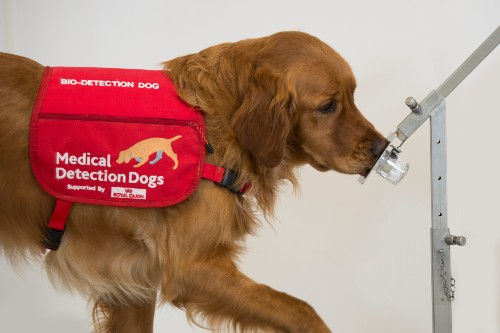
We all know that we have a primary sense: our vision. For dogs, however, their primary sense is their sense of smell, otherwise known as the olfactory system. Interestingly, almost a third of a dog’s brain is dedicated to smelling and analysing scents. This is 40 times larger than the region of the human's brain dedicated to smelling. Their sense of smell is so strong that dogs can detect odours at a concentration of 1 to 2 parts per trillion, equivalent to 5g of sugar in 1,000,000 gallons of water! Shocking, right? One can imagine the many great applications of this amazing skill in detecting early or hidden disease.
Amazing Anatomy
Like all animals, dogs have 2 nostrils, known as nares, which are divided by a bony septum made up of cartilage. Their long snout is composed of tiny, thin bones called turbinates, which are covered in epithelium (protective layer of tissue that can absorb or secrete certain fluids).
The anterior turbinates are maxillary (of the upper jawbone called the maxilla) and lined with mucus-producing epithelial cells. The mucus aids in dissolving odour molecules, so that these molecules can travel within inhaled air up to the top of the nose. The posterior turbinates, called ethmoid turbinates, are lined with olfactory epithelium and house a whopping 300 million olfactory receptors!
Dogs even have a special bone plate at the base of the nasal cavity, known as the Lamina Transversa, which separates the respiratory and olfactory sections. This bony plate allows odours to be accumulated and processed, despite air being exhaled at the same time. The nervous pathways then relay signals to the olfactory lobe in the brain where the odours are interpreted, along with other parts of the brain.
All these incredible features of their nasal anatomy allow them to process odour precisely and detect disease accurately.
The secret of sniffing
Surprisingly, sniffing isn’t another word for smelling in dogs. When dogs sniff, they inhale and exhale rapidly (up to 200 times per minute). This maximises the odour! Each nostril allows for bilateral intake of air, which is inhaled directly into the centre of the nostril. Air turbulence is created and tiny wind currents stir up more scent particles. For every breath, 12% of the air goes to the olfactory region. The other 88% goes to the lungs.
You might be wondering what are they sniffing so fast? Well, they sniff VOCs, otherwise known as Volatile Organic Compounds (particles that evaporate easily). Disease alters body metabolism, so small and volatile odour molecules are produced associated with the disease. They diffuse into the bloodstream and are excreted in bodily fluids like urine or sweat. They are even present in the air you breathe out!
Diseases detected so far...
Dogs can detect an array of ailments, ranging from infections to cancers.
Some examples are listed below:
Bacteria like Clostridium Difficile in contaminated air, surfaces and in stool
Bacterial urinary tract infections
Parasitic Malaria infection on patient clothing
Prostate cancer in urine
Lung and breast cancer in breath
Ovarian cancer in blood
Parkinson’s Disease in sebum
SARS-COV 19
Applications
Medical detection dogs can be used when affordable rapid diagnostic testing is needed, such as, during pandemics or localised outbreaks. These canines may be a life-changing solution in areas with limited facilities and inadequate testing equipment. They also play an instrumental part in disease detection research, helping to develop accurate and more efficient diagnostics.
These dogs can be used in highly populated areas like schools, where screening of students, teachers, and visitors could become necessary. Other areas of interest could include office buildings and industrial work sites with many workers. Also, people gathering for events like concerts and sport may be an important consideration.
Alternatively, these dogs could be used in the transport industry. Shipping of cargo could be checked to prevent the transportation of disease. They can help isolate ill passengers in airports or on railways. They can even be a necessity at boarder crossings to prevent endemic diseases spreading between areas.
Additionally, detection dogs could be useful in assisted living facilities, old-age home, rehabilitation centres and hospices to screen vulnerable residents, their visitors and the workers.
Another notable application would be in hospital settings, where medical detection dogs can be used in triage. As patients come into hospital, they could be screened for certain diseases or infections and put into categories based on the severity of their conditions. This may support medical staff, who are suffering from shortages around the globe.
Lastly, and possibly most importantly, would be medical alert dogs; the subgroup of medical detection dogs. These canines work exclusively with their owners to alert any upcoming episodes of illness. These dogs range from diabetic alert dogs, who monitor blood sugar levels, to seizure response dogs, who can alert for seizures and assist their owner before, during, and after said seizure. Other types of medical alert dogs include those working with heart conditions like POTS (Postural Orthostatic Tachycardia Syndrome) or severe allergies. They can also take on the role of a fluffy therapist, supporting owners with conditions like Autism, ADHD, Anxiety disorder and many more!
Training
The training to become a medical detection dog is rigorous! From as young as 8 weeks old, basic training of bonding, socialisation and obedience is started. From 12 to 16 weeks, they are introduced to a more formal training protocol, which includes scent marking behaviours, where they are introduced to biological samples.
Then, the scent discrimination stage starts to take place. They are taught to detect the “target odour” with diseased and control samples. They must choose the diseased sample and then differentiate between the “target scent” and many other scents on or in the sample. Luckily, dogs have a special way of analysing odours – processing each segment of the odour individually!
The dogs are further trained with positive reinforcement. When they detect the diseased sample, they are promptly given a reward, such as a treat, their favourite toy or a game. Repetition is key with any training, especially with dogs. They are tested many times with blind trials, where neither the dog nor the trainer is aware which sample is diseased. This ensures accuracy and precision of up to 90%! In some areas, these canines outperform traditional diagnostics, like urine analysis or breath tests, making them incredibly useful in the healthcare sector.
How to help...
There are various organisations around the globe who need funding to continue training medical detection and alert dogs. Some of them work purely on public donations. A simple donation or social media post raising awareness can go a long way! Without our help, many people may go without a loving companion caring for them in their illness. Without adequate support, many in need will be missing out on the furry talent of detecting sickness early enough.
Please see some links to organisations below:
bibliography
About Us (no date) Medical Alert Dogs SA. Available at: https://medicalalertdogs.co.za/what-we-do-1 (Accessed: 17 April 2026).
Adminjupiter (2025) Canine disease detection: Dogs trained to detect disease, Jupiter Internal Medicine. Available at: https://www.jupiterinternalmedicine.com/canine-disease-detection/#:~:text=Scent%20Discrimination:%20Dogs%20are%20exposed,identifies%20the%20disease%2Drelated%20sample. (Accessed: 17 April 2026).
Bomers, M. et al. (2014) A detection dog to identify patients with Clostridium difficile infection during a hospital outbreak, Science Direct. Available at: https://www.sciencedirect.com/science/article/abs/pii/S0163445314001698#:~:text=An%20expert%20in%20drug%20and,alerts%20during%2049%20sweep%20days (Accessed: 17 April 2026).
How to reward dogs with positive reinforcement training (no date) Humane World for Animals. Available at: https://www.humaneworld.org/en/resources/positive-reinforcement-training (Accessed: 17 April 2026).
Kokocińska-Kusiak, A. et al. (2021) Canine olfaction: Physiology, behavior, and possibilities for practical applications, Animals : an open access journal from MDPI. Available at: https://pmc.ncbi.nlm.nih.gov/articles/PMC8388720/#:~:text=The%20canine%20olfactory%20system%20can,the%20pharynx%20into%20the%20lungs. (Accessed: 17 April 2026).
Maughan, M.N. et al. (2022) The use and potential of biomedical detection dogs during a disease outbreak, Frontiers in medicine. Available at: https://pmc.ncbi.nlm.nih.gov/articles/PMC9014822/#:~:text=An%20established%20body%20of%20literature,disease%20(17)%20in%20sebum. (Accessed: 17 April 2026).
Punzalan, J. (2025) The Use of Dogs for the Detection of Infectious Diseases and Emerging Diagnostic Options, CJIC. Available at: https://cjic.ca/content/current-issue/98-winter-2023/385-the-use-of-dogs-for-the-detection-of-infectious-diseases-an-emerging-diagnostic-option (Accessed: 17 April 2026).
RITPlatforms (no date) The science behind the sniff, Medical Detection Dogs. Available at: https://www.medicaldetectiondogs.org.uk/the-science-behind-the-sniff (Accessed: 17 April 2026).
Warli, S.M. et al. (2023) The olfaction ability of medical detection canine to detect prostate cancer from urine samples: Progress captured in systematic review and meta-analysis, World journal of oncology. Available at: https://pmc.ncbi.nlm.nih.gov/articles/PMC10588501/#:~:text=To%20date%2C%20early%20cancer%20detection,estimation%20on%20urine%20odor%20testing. (Accessed: 17 April 2026).


Comments